Editor’s note: African-Startups is a sister publication of EU-Startups, bringing trusted coverage of startups, venture capital, and innovation across Africa.
FourthMainland, Nigeria’s leading content and culture group, has invested in Storipod, a Nigerian-built media technology platform that enables creators to publish, distribute, and earn from their work.
The investment came through FourthMainland Fund, the investment arm of FourthMainland, and as part of the investment, Chude Jideonwo, founder of FourthMainland, has joined the board of Storipod as Chair.
“The global platforms have entered African markets, gathered enormous audiences and become essential infrastructure for our creative industries. Yet too many times, when African creators need these companies most, the infrastructure suddenly becomes distant, opaque and unaccountable,” said Chude.
Storipod was founded in 2023 by James Nelson, who previously worked at Interswitch, Coca-Cola HBC, AXA, Shuttlers, and Edukoya. The platform acts as a distribution infrastructure for the business of storytelling, and it grew out of a simple observation: audiences that ignored long-form blog posts would readily consume the same content when it was broken into short, sequential, mobile-first pieces.
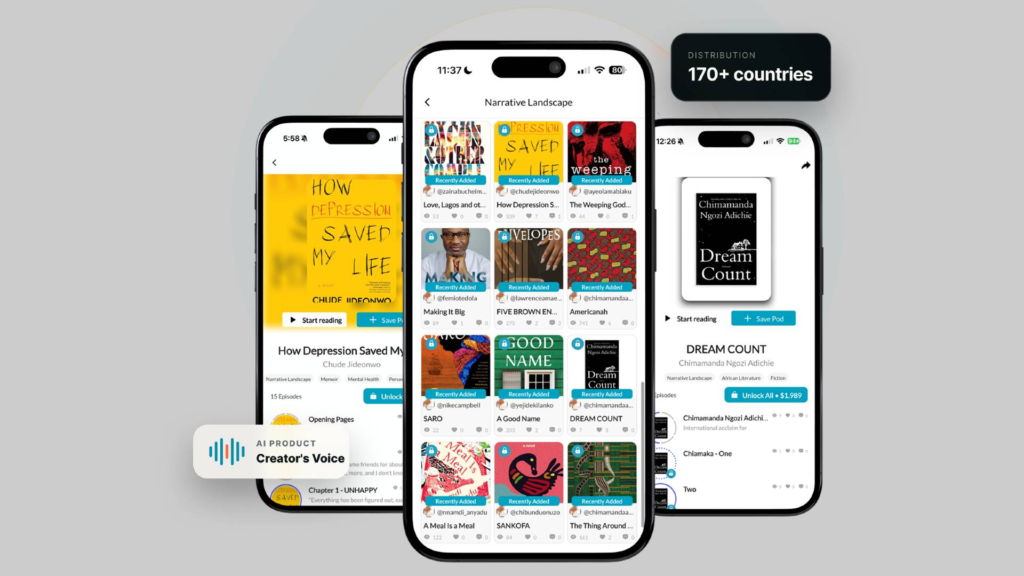
The platform allows writers to publish serialised stories, build communities around their work, and earn directly from readers through paid story unlocks, subscriptions, and tipping. Storipod says creators retain between 70 and 80% of content revenue, depending on the product tier, and cross-border payouts are built around payment infrastructure suited to African markets.
Since its launch, Storipod has grown from 2,000 to more than 200,000 users, logged over 12 million story reads and reached audiences in more than 170 countries. It has also moved beyond independent creators into formal publishing, securing a distribution partnership with Narrative Landscape Press that has brought books by major African authors, including Chimamanda Ngozi Adichie, to mobile readers.
For FourthMainland, the decision to back Storipod makes sense. The group is Africa’s foremost storytelling and content hub, reaching millions daily through a portfolio that includes digital media company YNaija, the counterculture teaching platform Joy Inc., and Chude Jideonwo Presents, which chronicles the emotional lives of Nigerians and Africans. It is a sister group to the communications conglomerate RED | For Africa, which has worked with global brands across 23 African countries over more than two decades.
FourthMainland’s core business is building and monetising African stories and audiences, which is the infrastructure Storipod has successfully built. In a Substack post explaining the investment rationale, Jideonwo says African creators have built large audiences and businesses on global platforms, only to find those platforms distant, opaque and unaccountable when things go wrong. He cited account suspensions, automated demonetisation, copyright claim abuse and an inaccessible appeals process as threats to the livelihood of African creators.
“When a creator’s page disappears, a business can disappear with it. Salaries, contracts, archives, intellectual property, reputation and access to customers can vanish because an algorithm misunderstood a video or because strangers organised themselves in a WhatsApp group to report someone as retribution,” he wrote.
FourthMainland has spent years understanding how African audiences engage with content, what makes them return, and how to convert attention into sustainable value; Storipod is building the technology rails on which that understanding can be applied at scale.
“FourthMainland brings decades of experience in media, content, audiences, creator businesses and the difficult work of turning attention into sustainable value. Storipod brings product, engineering and a platform already proving that African storytelling can be distributed and monetised differently. The fit is obvious,” added Jideonwo.
In the long term, FourthMainland sees Storipod becoming “the technology layer for the business of African stories” and building an infrastructure that isn’t closed but rooted in African realities and scalable worldwide.