

Editor’s note: African-Startups is a sister publication of EU-Startups, bringing trusted coverage of startups, venture capital, and innovation across Africa.
Africa Jobs Fund, a new philanthropic venture fund, has launched with an ambition to mobilise $100 million in philanthropic capital to build companies that create high-productivity jobs for Africa’s next generation. The fund is co-founded by Daniel Yu, who previously built Wasoko into Africa’s largest B2B e-commerce company, and Ben Hyman, founder of Talent Safari, a recruitment firm for African startups.
In a blog post, Hyman argues that the only way to improve the quality of life at scale is raising incomes and the only way to raise incomes is by building firms that create higher-productivity jobs.
“The only way this has ever been achieved in a durable way is through economic growth and income increases,” Hyman wrote on LinkedIn. In order to achieve this goal, the Africa Jobs Fund has identified two sectors it believes are grossly under-funded relative to their potential impact: international labour mobility and export manufacturing.
On international labour mobility, the fund points to the enormous wage differential between Africa and OECD countries as both a structural problem and an untapped opportunity. GDP per capita in Malawi stands at roughly $550, compared to over $55,000 in Germany, which is a 100x gap. The fund says moving a worker from Malawi to Germany can increase their personal income by 25x, and if they remit just 10% of their earnings home, they can double the incomes of ten family members.
“Not only will they be far better off, but they might be able to double the income of their whole family through the remittances they send home,” Hyman observes.
According to the founders of the Africa Jobs Fund, the opportunity is enormous but the pathway remains broken. They argue that workers from the lowest-income countries face confusing bureaucracy, prohibitive upfront fees, and a shortage of ethical recruiters, language schools, and financing partners. The fund intends to build a new generation of companies to fix this market failure.
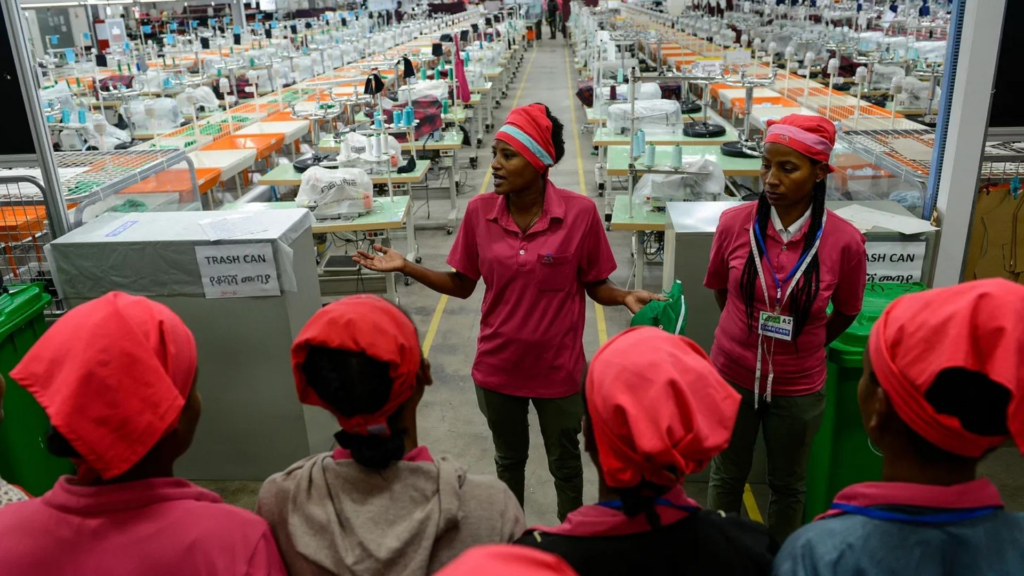
On export manufacturing, the fund argues that countries that have become rich share a common thread: they industrialised. Britain, Germany, the United States, Japan, China, Poland, Turkey, and Mauritius all followed this path.
Workers in export factories are roughly 5x more productive than those in subsistence agriculture, and selling to global markets removes the ceiling imposed by limited local demand. With Africa holding favourable tariff access to the US, EU, GCC, and China, and wages rising in traditional manufacturing hubs, the continent is seen as ripe for an industrial boom.
The fund is initially raising $15 million to build at least 20 high-impact companies, deploying capital through two approaches: venture building, where it identifies gaps, recruits founders, and provides seed capital and operational support; and catalytic capital, backing existing businesses expanding into high-impact verticals that commercial markets have overlooked. It projects the effort could generate upwards of $50 billion in income gains for low-income Africans, a 500x return on invested philanthropic capital.
All spending is benchmarked against a cost-effectiveness target of less than $10 in philanthropic subsidy per year of doubled income, which the founders claim is better than the $40 benchmark set by GiveWell’s top global health charities. “By backing world-class founders to build pioneer firms in these spaces, we believe we can generate an enormous RoI, orders of magnitude larger than typical livelihoods programmes or venture startups,” the announcement stated.
Yu and Hyman are supported by Samantha Power, former head of USAID and US Ambassador to the United Nations, and Iyinoluwa Aboyeji, co-founder of African unicorns Andela and Flutterwave. The fund is housed within Renaissance Philanthropy, a nonprofit specialising in thesis-driven philanthropic funds.
“We’re on the lookout for world-class impact-motivated founders, forward-thinking and effectiveness-minded funders and anyone else who’s excited to support our mission,” Hyman added.