
Editor’s note: African-Startups is a sister publication of EU-Startups, bringing trusted coverage of startups, venture capital, and innovation across Africa.
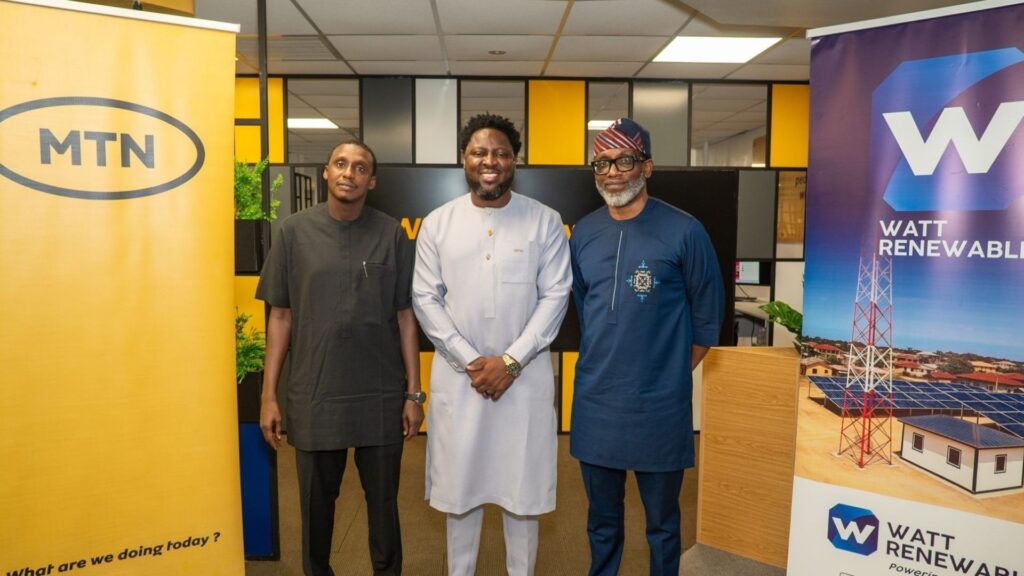
First WATT Renewable Limited and MTN Nigeria have entered a renewable energy infrastructure partnership aimed at curbing the telecom giant’s reliance on diesel generators. The strategic partnership strengthens operations at MTN Nigeria’s most critical facilities, and powers a new network of electric vehicle charging stations across the country.
In a press release, First WATT Renewable Limited states that the partnership is structured around two major components. The first is an Energy-as-a-Service arrangement under which First WATT Renewable, a subsidiary of WATT Renewable Corporation, will deploy roughly 34 MWp of solar photovoltaic generation capacity alongside 40 MWh of battery energy storage across a range of MTN sites nationwide.
These locations include data centres, switch facilities, cable landing stations and customer service centres, installations the telecom operator considers essential to keeping its network running.
The second component focuses on mobility. First WATT Renewable will supply renewable energy infrastructure to power 60 kW EV charging stations at eight MTN facilities spread across Ikoyi, Matori, Ojota, Abuja, Port Harcourt, Asaba, Kano and Ibadan, according to the announcement.
Diesel generators have long been the default backup, and even primary, power source for telecom infrastructure in Nigeria, given the unreliability of the national grid. Both elements of this new programme are intended to chip away at that dependence. By combining solar generation with battery storage, the partners say the deployment should cut emissions, improve uptime at critical sites, and bolster business continuity for MTN’s network operations.
The companies project that, based on current assumptions, the programme could help avoid roughly 25,000 tonnes of carbon dioxide equivalent emissions over five years, though the press release notes this figure remains subject to operational performance and final emissions calculations.
“This partnership is a defining milestone for First WATT and an important step in strengthening the energy infrastructure that supports Nigeria’s digital economy. By deploying solar photovoltaic generation and battery energy storage across selected MTN facilities, we are helping to improve energy reliability at critical locations where uptime is essential,” said Oluwole Eweje, Chief Executive Officer of WATT Renewable Corporation.
He added that the EV charging component shows how renewable infrastructure can support Nigeria’s shift toward lower-carbon transport, addressing what he called one of the central requirements for broader EV adoption, a reliable and cleaner power supply.
Tobechukwu Okigbo, Chief Corporate Services and Sustainability Officer at MTN Nigeria, said, “As Nigeria’s energy and mobility landscape evolves, renewable energy will play an important role in building cleaner and more reliable infrastructure. This partnership supports our efforts to reduce diesel dependence, improve operational efficiency, and strengthen the resilience of the systems that power connectivity.”
The tie-up comes as digital demand across Nigeria continues to climb, putting growing pressure on telecom operators to maintain reliable infrastructure. For MTN Nigeria, which serves more than 89 million customers and forms part of the wider MTN Group, operating across 16 countries and reaching over 300 million people, the partnership represents a step toward integrating renewables more deeply into core operations rather than treating clean energy as a peripheral initiative.
First WATT Renewable, which operates under WATT Renewable Corporation founded in 2016, aims to use sustainable energy to strengthen infrastructure and unlock long-term development. The company’s early work centred on Nigeria’s telecommunications sector, where it built up experience supporting tower companies with renewable power, an approach it later extended to mobile network operators, financial institutions and other commercial and industrial clients.
Its core strength lies in its Power-as-a-Service model, which is a fully managed hybrid solar offering that bundles generation, battery storage, intelligent energy management, and round-the-clock monitoring and maintenance into a single subscription, allowing clients to access reliable power without managing the underlying infrastructure themselves.
It is now bringing this proven track record to MTN and extends its track record in hybrid solar deployment across telecoms, tower companies, financial institutions and commercial and industrial clients, reinforcing its position as a player in Africa’s push toward more resilient, lower-emission infrastructure for critical digital services.
“[This partnership] is also aligned with Project Zero, under our Doing for Planet sustainability pillar, through which we are focused on reducing greenhouse gas emissions, improving energy efficiency, and increasing the use of renewable energy across our operations,” added Okigbo.