
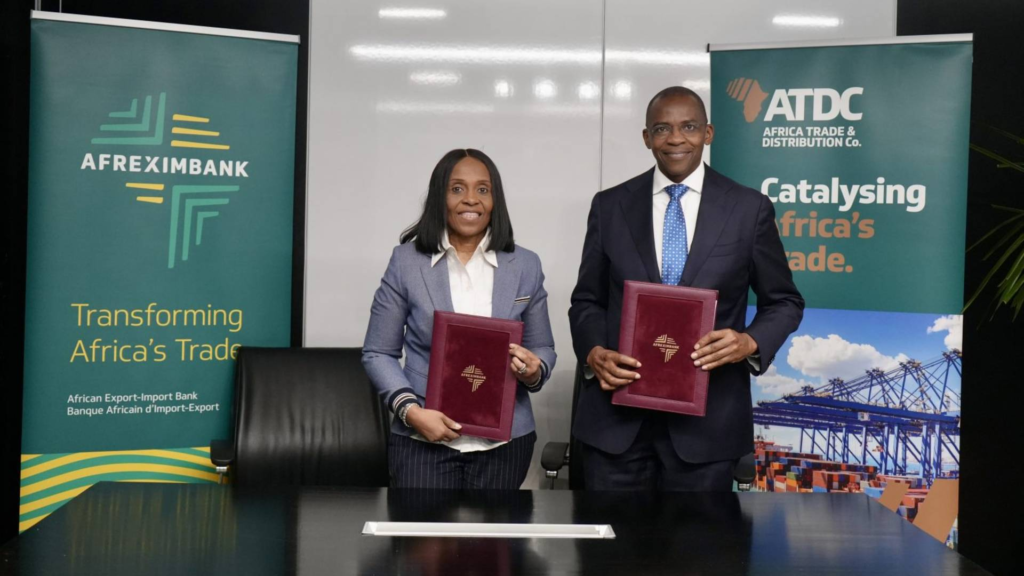
The African Export-Import Bank (Afreximbank) and the Africa Trading and Distribution Company (ATDC) have signed a $500 million Global Credit facility agreement to support the trade, movement and distribution of commodities and products across African and global markets.
Under the facility, Afreximbank will supply ATDC with trade-finance capacity to undertake and scale eligible trading and distribution deals across the continent.
“The $500 million Global Credit Facility extended to ATDC underscores Afreximbank’s commitment to strengthening the trade, logistics and distribution architecture required to realise the full potential of the African Continental Free Trade Area (AfCFTA),” said Kanayo Awani, Executive Vice President, Intra-African Trade and Export Development, Afreximbank.
As a pan-African multilateral financial institution, Afreximbank works with the mandate to finance and promote trade within and beyond the continent. Over more than 30 years, the bank has built financing pillars aimed at transforming the structure of Africa’s trade and accelerating industrialisation and intra-regional commerce.
It is a backer of the African Continental Free Trade Area (AfCFTA) and runs the Pan-African Payment and Settlement System (PAPSS), which the African Union adopted as the payment platform underpinning AfCFTA’s rollout. Together with the AfCFTA Secretariat and the AU, it has also set up a $10 billion Adjustment Fund for countries participating in the free trade area.
In September last year, ATDC was launched as an Afrexim-backed pan-African trading and distribution platform to strengthen the continent’s trade infrastructure and advance AfCFTA implementation. It was supported by Afreximbank’s Fund for Export Development in Africa (FEDA), which saw Emmanuel Assiak join as CEO in June. Other collaborators include Arise Integrated Industrial Platforms, Equitane DMCC and the AfCFTA Secretariat. At launch, ATDC secured a $1 billion funding pledge from Afreximbank and unveiled its minerals and hydrocarbons subsidiary, ATDC Minerals (ATMIN).
Through commercially sustainable trading, aggregation, logistics and distribution platforms, ATDC connects producers, manufacturers and markets across Africa, working to improve market access, supply chain efficiency and value addition. It currently has local operations in Egypt, Nigeria, Malawi and Zimbabwe and is building scalable models to deepen intra-African trade and strengthen regional value chains.
“Realising Africa’s full trade potential requires reliable systems that connect producers, processors, manufacturers and markets. This facility strengthens ATDC’s ability to aggregate supply, mobilise working capital and move goods efficiently across value chains. Together with Afreximbank, we will support stronger supply chains, value addition, import substitution and intra-African trade,” said Stewart Makura, Chief Executive Officer of ATDC.
The credit facility is earmarked for purchasing and aggregating African goods, along with the logistics, transportation, warehousing and distribution costs that come with moving them, giving ATDC funding across different stages of the trade and distribution cycle. ATDC will repay the facility from proceeds generated by the sale of the goods it finances through it.
The credit facility to ATDC comes after Afreximbank extended a $10 million facility to Azania Bank to support SMEs in Tanzania. Last month, it signed the largest ever $127 million financing deal with Chad to back trade and infrastructure projects.
Beyond financing individual transactions, the facility is meant to help ATDC develop repeatable trade corridors and expand access to dependable sourcing and distribution networks across African markets, supporting commercially sustainable trade flows, greater processing of African commodities, and increased regional availability of raw materials, inputs and value-added products.