
Editor’s note: African-Startups is a sister publication of EU-Startups, bringing trusted coverage of startups, venture capital, and innovation across Africa.
In 2008, the Kenyan government sold a 25% stake in the mobile operator Safaricom to raise around $800 million. To date, it remains the benchmark for a successful IPO in Africa, but that is set to be shattered when Dangote Petroleum Refinery opens its IPO later this month. The IPO is seen as a reckoning for Africa‘s capital markets, which hasn’t seen IPO activity of this kind since 2019, when Airtel Africa, Jumia, and MTN Nigeria made their respective market debuts within months of each other.
In October 2026 alone, three major African-linked companies filed for or began trading on public exchanges, a density not seen before. If Dangote’s IPO proceeds at anything close to its reported targets, it would likely raise over $1 billion, putting it ahead of every deal on the list of the top 6 African IPOs and cementing it as Africa’s largest IPO on record.
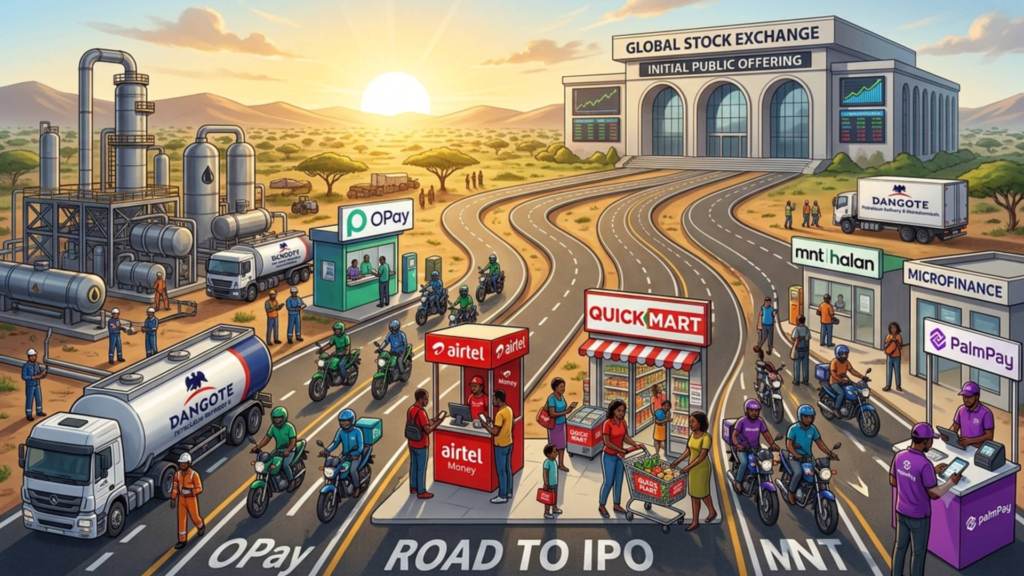
But Dangote is not alone. Nigerian FinTech OPay has filed an F-1 with the US Securities and Exchange Commission, while Airtel Money has already begun trading in London. MNT-Halan, the first FinTech unicorn from Egypt, has also announced plans for a Cairo IPO, while PalmPay and Quickmart are drawing up plans for Hong Kong and Nairobi IPOs. This is IPO season in Africa, and here’s everything you need to know about these IPOs.
Dangote Petroleum Refinery IPO
What it does: Dangote Petroleum Refinery and Petrochemicals FZE has triggered the IPO market in Africa. Located in Lekki, near Lagos, the refinery began operations in 2024 and has a processing capacity of about 65,000 barrels of crude oil daily. It produces petrol, diesel, aviation fuel, and other petroleum products, reducing Nigeria’s historical dependence on imported refined fuels.
Exchange targeted: Nigerian Exchange (NGX), with access via Global Depositary Receipts (GDRs) on the Nairobi Securities Exchange for Kenyan investors.
Amount targeted: Nigeria’s Dangote Group is selling 4.1 billion shares in its oil refinery to raise $1.6 billion (2.15 trillion naira). This is set to become Africa’s largest initial public offering to date.
Valuation: At the offer price, the company is valued at approximately $47 billion.
Offer window: The application period for the initial public offering was initially due to close on October 13 but has now been extended by two weeks to October 27 due to strong investor demand.
Financials: Ahead of its listing on the Nigerian Exchange, the company swung to a net profit during the first nine months of 2026. According to unaudited results released on Tuesday, the company posted a net profit of $4.73 billion for January to September, compared to a loss of $117.2 million during the same period last year. Its revenue more than doubled, rising from $9.19 billion to $22.48 billion while EBITDA jumped to $5.52 billion from $627.6 million, driven by higher crude processing rates, stronger refining margins and improved operations.
Market Watch: The refinery has benefited from rising demand for its products amid supply disruptions linked to the Iran War, helping the company to sell jet fuel to Western Europe. It aims to double refining capacity to 1.4 million bpd by 2029, while billionaire Aliko Dangote, President of the Dangote Group, has called the listing “the people’s IPO,” a reference to his ambition to attract millions of ordinary African investors.
Other factors: The IPO represents only about 3% of the company’s equity, meaning the existing shareholders remain firmly in control. Since the IPO is linked to just one facility, any equipment failure, shutdown and crude oil supply disruptions could impact its earnings.
OPay IPO
What it does: OPay Limited is a Nigerian FinTech providing digital payments and lending services across Nigeria, Indonesia, Egypt, and Pakistan. It allows consumers and merchants to make payments, transfer money and access credit through its platform. It was founded by Chinese billionaire Yahui Zhou, who also founded Beijing Kunlun Tech and serves as the chairman of Opera Software. SoftBank entities own a 6.6% stake in OPay before the offering.
Exchange targeted: OPay has applied to list its American Depository Shares (ADRs) on the NYSE under the symbol “OPAY.” It has roped in Citigroup, Deutsche Bank, Standard Bank, and CICC as underwriters for the offering.
Amount targeted: According to reports, OPay is planning to raise up to $500 million through a combination of the IPO and concurrent private placements. Ahead of the IPO, Standard Bank Group, Africa’s largest bank by assets, announced an agreement to invest up to $200 million in OPay.
Valuation: The company is reportedly targeting a valuation of approximately $4 billion.
Offer window: OPay has not confirmed the public offer window or date for its US IPO but it is expected to list before the end of the year.
Financials: According to OPay’s Form F-1, the Nigeria-focused FinTech company’s net income rose to $90.9 million from $21.7 million a year earlier. Revenue more than doubled to $467.1 million from $197.5 million in the six months ended June 30.
Market Watch: OPay was the leading finance app with a 9.9% market share in Africa and the Middle East based on monthly active users in the first half of 2026. The company processed 90.1 billion transactions, which represents $558 billion in gross transaction value for the 12 months ending 30 June 2026. OPay plans to pursue a secondary listing in Nigeria after completing its NYSE listing.
Other factors: During the first half of 2026, Nigeria contributed 89.5% of OPay’s revenue, which makes its business vulnerable to exchange rate fluctuations.
Airtel Money IPO
What it does: Airtel Mobile Commerce, also known as Airtel Money, is the Amsterdam-based mobile money business of London-listed telecommunications provider Airtel Africa PLC, which raised approximately $750 million through a simultaneous listing in London and Lagos in 2019. Airtel Money provides mobile wallet, money transfer and savings services across 13 African markets.
Exchange targeted: London Stock Exchange (LSE) under the ticker AMC.
Amount targeted: The company set the offer price at £1.96 per share, and the final offer comes to £582 upon exercising the over-allotment option.
Valuation: The offer price valued the mobile money business at $7 billion (£5.3 billion).
Offer details: The IPO offer consisted of 270 million existing shares sold by the company’s minority shareholders, which means the IPO raises no new capital for the company itself. The International Finance Corporation (IFC) has been allocated 34,285,714 shares worth £67.2 million, its full commitment as a cornerstone investor.
Market Watch: Airtel Money IPO was London’s largest public offering since financial services provider Wise Group listed in 2021 with a £8 billion market cap. “Today is a landmark moment for Airtel Money. Our listing in London marks an important new chapter for our business and reflects what we have built across Africa and the significant opportunity ahead,” said Airtel Money Chief Executive Ian Ferrao.
Other factors: The listing took place later than planned. Airtel had initially planned to list the money business in the first half of 2026 but decided to push back the IPO to the second half. Airtel Money shares traded at 181.28p each on Wednesday, giving it a market cap of £4.9 billion. The stock is down 7.5% from the 196 pence offer price.
MNT-Halan IPO
What it does: MNT-Halan is Egypt’s leading lending and payments company founded by Mounir Nakhla. It holds 24.3% of the country’s non-bank microfinance market by loan book and 14% of non-bank consumer finance by annual disbursements. It is also Egypt’s largest non-bank lender to small businesses. Since its launch, the group has disbursed more than $15.5 billion in financing and serves over 8 million customers
Exchange targeted: Egyptian Exchange (EGX), under the ticker HALN or HALN.CA
Amount targeted: The company plans to sell 320 million shares to institutional and retail investors, representing a 20% free float. All of the shares on offer are existing shares held by the parent company, MNT Investments B.V., with a share price of EGP 24.5 per share and a target raise of $150 million (EGP 7.84 billion).
Valuation: Initially, the bankers for MNT-Halan were targeting a valuation of $1 billion, but the company recently raised money in a round led by Al Ahly Capital, the investment arm of the state-owned National Bank of Egypt, at a valuation of $1.4 billion in June.
Offer window: The offer window opened on 7 October 2026, with the institutional private placement closing on 13 October 2026, and the retail public offering closing on 15 October 2026.
Market Watch: Commercial International Bank (CIB) has entered into a cornerstone investment agreement with MNT-Halan by committing to purchase shares for an aggregate investment of up to EGP 2 billion.
Other factors: The listing only covers MNT-Halan’s operations in Egypt. The wider group also owns businesses in Pakistan, Turkey, and the United Arab Emirates.
Quickmart IPO
What it does: Quick Mart PLC is a homegrown Kenyan supermarket chain that sells fresh food and everyday consumer products. The company operates 72 stores nationwide, serves more than five million customers monthly and works with over 700 suppliers. It also runs a loyalty programme called Q-Points, which has more than 2.5 million members.
Exchange targeted: Nairobi Securities Exchange’s Main Investment Market Segment.
Amount targeted: The IPO involves the sale of 2 billion existing ordinary shares, representing 50% of Quickmart’s issued share capital. The offer price is $0.06 (KES 7.50) per share, and Sokoni Retail Kenya Limited, the shareholder selling, is expected to pocket approximately $111 million (KES 14.4 billion), but Quick Mart will not receive any of the proceeds because this IPO does not involve issuing new shares.
Valuation: At $0.06 (KES 7.50) per share, the IPO implies an equity valuation of $231 million (KES 30 billion) for the company.
Offer window: The offer opened on 5 October 2026 and is scheduled to close on 30 October 2026. The company is expected to begin trading on 12 November 2026, as per the published IPO timetable.
Financials: Quick Mart reported revenue of $388.4 million (KES 50.4 billion) in 2025 and adjusted profit after tax of $13.1 million (KES 1.7 billion).
Market Watch: The International Finance Corporation has conditionally agreed to participate as a cornerstone investor in the offer. It has conditionally agreed to buy approximately $15 million (KES 1.94 billion) of offer shares (about 12.9% of the offer and 6.45% of Quickmart’s total share capital after listing) on the same terms as other investors. Its commitment is subject to conditions, including its own board approval.
Other factors: The primary question here is whether Quick Mart can justify its $231 million (KES 30 billion) valuation. There is also the potential risk of retail consolidation, erosion of profitability, expansion costs and Quick Mart’s IPO cautions investors that they could lose some or all of their investment.
PalmPay IPO
What it does: Founded in 2019, PalmPay is an Africa-focused FinTech whose services include transfers, bill payments, savings, cards, credit and insurance offered through partners. The company operates consumer businesses in Nigeria, Tanzania and Bangladesh, with business payment services in Ghana and South Africa. It has more than 35 million registered users and about 1 million business clients. PalmPay launched in Nigeria after raising $40 million in Seed funding from investors led by Transsion Holdings, the Chinese parent company of Tecno, Infinix, and Itel phones. Other backers include NetEase and MediaTek.
Exchange targeted: Hong Kong Stock Exchange
Amount targeted: The Africa-focused FinTech is reportedly seeking about $200 million from investors.
Valuation: The offer values the company at more than $1 billion, giving PalmPay unicorn status.
Offer window: Like OPay, PalmPay has not set an official IPO offer window or listing date.
Financials: PalmPay became profitable in 2025. According to Launch Base Africa, its revenue doubled from $64 million in 2023 to more than $128 million in 2024.
Market Watch: A Hong Kong listing is widely seen as a way to access a large pool of Asian institutional investors already familiar with the mobile payments business model.
Other factors: The PalmPay IPO is in the early stages, and the fundraising amount, valuation and even the IPO plan are subject to change.
Africa has not seen such an IPO wave in recent times. While Dangote is the talking point, the likes of OPay, Airtel Money, and others show that a range of non-traditional businesses are waiting in the wings to go public. These six listings have the strength to shift how African businesses access capital and open the doors for investors from London to New York to Hong Kong to enter Africa’s IPO market.