
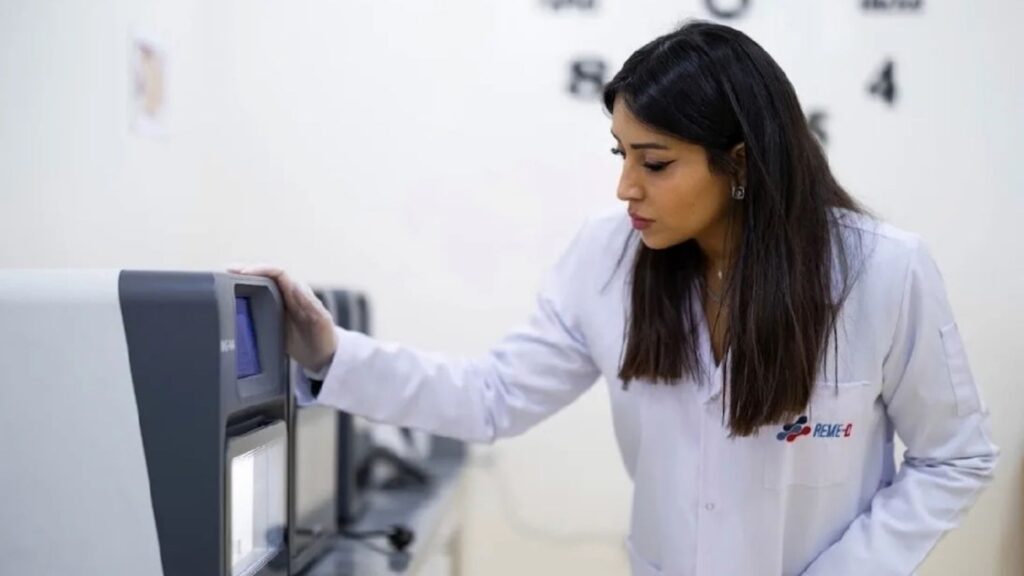
Reme.D, an Egyptian BioTech startup manufacturing locally produced, room-temperature-stable medical test kits designed for health settings across Africa and the Middle East, has secured a $500k equity investment from Global Innovation Fund (GIF).
The Global Innovation Fund is a non-profit, impact-first investment fund headquartered in London with offices in Washington, D.C., Nairobi and Singapore. It invests in the development, rigorous testing, and scaling up of new products, services, business processes, or policy reforms that are more cost-effective than current practice and targeted at improving the lives of the world’s poorest people. This investment from GIF will support Reme.D’s expansion into a new, purpose-built 2,000 sqm facility, enabling the company to significantly increase production.
“We are delighted to announce our investment in Reme.D, a company that is tackling one of the most fundamental gaps in African healthcare by manufacturing high-accuracy molecular diagnostics locally, affordably, and without dependence on cold chains. Reme.D has built an impressive track record of technical innovation, commercial traction, and genuine impact and we are excited to support Salma and her team as they scale into new markets and demonstrate what homegrown African diagnostics can achieve,” said GIF Managing Director and deal lead, Lily Steele.
Founded in 2022 by Salma Tammam, Reme.D develops and manufactures disease diagnostic testing systems that are suited for use in low-resource settings.
According to GIF, diagnostic capacity across Africa is still severely limited. Approximately 30% of health facilities are equipped for basic testing, and just 19% of primary care facilities have these tools. For communicable diseases like HIV, tuberculosis, and hepatitis, this gap causes delays in diagnosis, missed treatment opportunities, and preventable deaths.
Imported medical tests are often unaffordable or inaccessible. High costs, reliance on continuous cold chains, and designs tailored for well-funded laboratories have kept high-accuracy testing out of reach in the settings that need it most. Reme.D was founded to change that.
The startup designs and produces its diagnostic kits locally in Cairo. It claims that by utilising proprietary nanotechnology and freeze-drying methods, its testing components can remain effective at temperatures exceeding 30°C without refrigeration.
By removing the need for constant refrigeration in markets where electricity is unreliable, the technology reduces waste and delays in emergency procurement that disrupt traditional diagnostic services in these regions. By decoupling molecular diagnostic capacity from refrigeration and stable power supply, Reme.D claims to strengthen health system resilience against both climate-induced supply shocks and the rising burden of climate-sensitive diseases such as dengue, Zika, and monkeypox.
Reme.D also claims that it offers testing at just a quarter of the price of imported alternatives. Its product range covers 30 infectious and non-communicable diseases, utilising mobile testing units capable of delivering vital diagnostic services to remote areas and emergency settings.
Its product suite also includes tests for HPV and other women-specific conditions, and the company has been working with a government hospital in Cairo to provide free HPV screening to women from underserved communities.