
Editor’s note: African-Startups is a sister publication of EU-Startups, bringing trusted coverage of startups, venture capital, and innovation across Africa.
Blockradar, a Nigeria-founded stablecoin infrastructure startup, has processed its first $1 billion in transaction volume. The transaction milestone comes as the two-year-old firm scales across dozens of countries.
In a LinkedIn post, the firm said the transaction volume reflected real-world use cases including businesses paying suppliers across borders, families receiving remittances from abroad, FinTechs helping customers convert between stablecoins and local currency, and companies launching financial products in markets that traditional infrastructure has struggled to serve.
“Earlier in my career at Braintree, I remember when the company crossed 1 billion transactions. I remember how big that milestone felt, how we celebrated, and what it felt like to be part of something so great. Fast forward several years, and Blockradar has now crossed a billion milestone of our own: our first $1B in transaction volume,” said Morgan Williams, co-founder and COO of Blockradar.
Blockradar’s own Dune Analytics dashboard, which tracks stablecoin volume flowing through its addresses onchain, put the figure slightly higher: at the time of writing, the dashboard showed $1.11 billion in total onchain volume, alongside 168,930 addresses generated across the ten blockchain networks Blockradar operates on.
The dashboard also broke volume down by stablecoin, showing USDC with a clear lead over USDT, roughly $620 million versus $420 million. Notably, the dashboard’s methodology excludes transfers between Blockradar’s own addresses, meaning the figure reflects genuine onchain activity rather than internal movement.
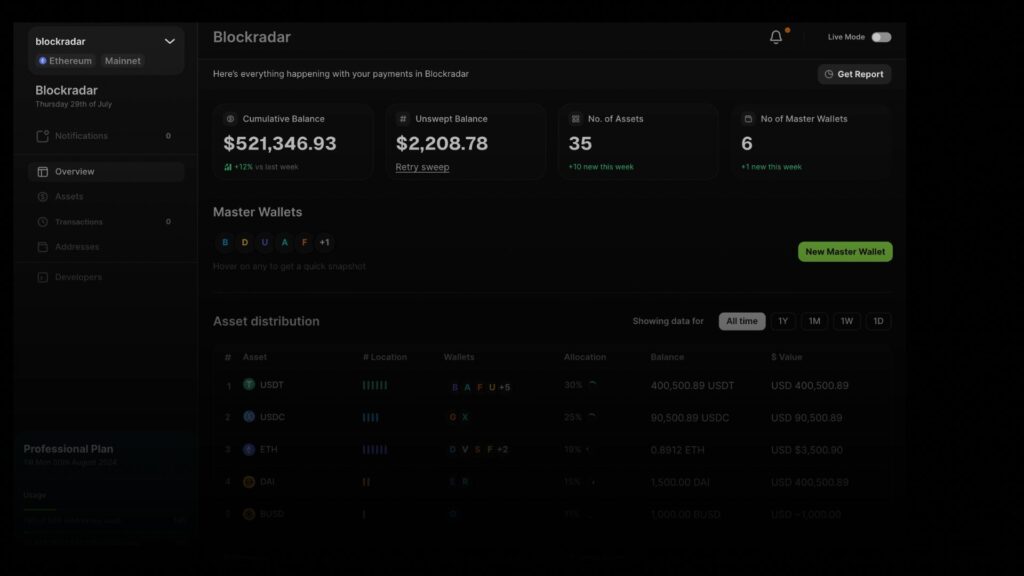
Founded in 2024 by Abdulfatai Suleiman and Williams, Blockradar is building secure stablecoin wallet infrastructure for FinTechs. It provides the underlying rails that allows financial technology companies to issue, move, and manage stablecoins – digital currencies pegged to assets like the US dollar – without having to build blockchain infrastructure from scratch.
In the real world, FinTechs can plug into Blockradar’s wallet and transaction infrastructure to power cross-border payments, remittances, and stablecoin-to-local currency conversion for their own end users. The $1 billion transaction volume announced by Blockradar represents the cumulative transaction volume processed through this infrastructure since the company’s founding.
Stablecoin infrastructure is seeing major interest from consumers across Africa, where currency volatility and limited access to dollar liquidity have pushed consumers and businesses towards dollar-pegged digital assets for savings, payments, and cross-border trade.
Nigerian and pan-African FinTechs have increasingly built products atop stablecoin rails to move money faster and at accessible rates than traditional banking infrastructure allows. In this shift, infrastructure providers like Blockradar position themselves as the plumbing beneath the consumer-facing products.