

Editor’s note: African-Startups is a sister publication of EU-Startups, bringing trusted coverage of startups, venture capital, and innovation across Africa.
Tanzanian AgTech company East Africa Foods (EAF) has secured $40 million to scale its phygital infrastructure connecting smallholder farmers.
The financing includes a $26 million in Series B equity round led by the Private Infrastructure Development Group (PIDG) through its growth equity and project development solution, InfraCo, alongside Dutch Entrepreneurial Development Bank FMO and impact investor Oikocredit. The round also saw previous backers ARAF, Goodwell, Africa Eats, and FINCA reinvest in the firm, while EKTA Partners served as the financial advisor.
The equity round completes the broader capital raise of approximately $40 million, including investment from existing shareholders, along with debt funding from the Schmidt Family Foundation.
“EAF’s offering aligns well with PIDG’s mandate to deliver inclusive, climate-resilient growth across the countries in which we operate. Strengthening EAF’s presence in Tanzania, and expanding its efficient, data-driven business into Kenya, will enable the company to mobilise future finance into this vital sector, underpinning improved food security across the region,” said Claire Jarratt, PIDG Head of Investment Management for InfraCo.
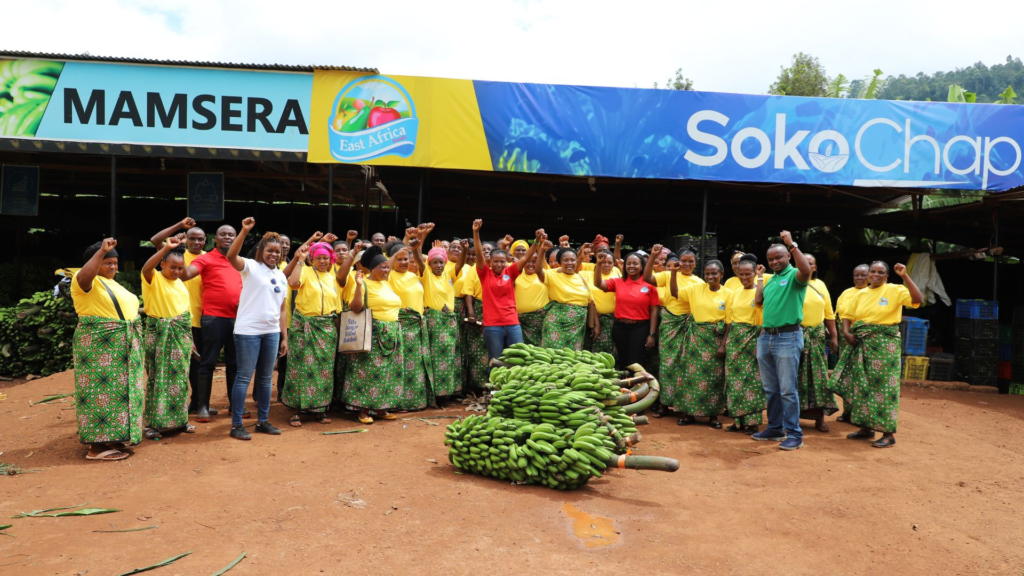
Founded in 2013 to address one of sub-Saharan Africa’s most persistent economic inefficiencies, East Africa Foods (EAF) operates an integrated AgriTech and agri-logistics platform in Kenya and Tanzania. The company sources produce directly from more than 28,000 registered smallholder farmers, then aggregates, grades, stores, processes, and delivers it to more than 10,000 urban retailers.
It also sells to consumers under its own brands, including Onja and Golden Banana. According to the PIDG, EAF has been effective in reducing post-harvest food loss by a third, a meaningful impact that helps farmers and consumers across the continent. In East Africa, post-harvest loss is not a farming problem but a logistical one. The problem is often the disconnect between what smallholder farmers produce and what reaches an urban shelf, and EAF has been building that missing layer.
“A third of what our farmers grow never reaches anyone’s table. That is not a farming problem: it is an infrastructure problem, and it is solvable,” said Elia Timotheo, founder and Chief Executive Officer of East Africa Foods.
He added, “For the past three years we have been building the layer this market is missing: the sourcing network, the fleet, the storage, and the technology that sit between a smallholder farm and an urban shelf. This investment enables us to further improve and scale this physical and digital infrastructure. We would like to thank our investors for their support in scaling this vital infrastructure.”
The new capital will be used by EAF to finance its next phase of expansion. The company wants to grow its processing, storage and logistics capacity, deepen its digital platform, and enter new markets beyond Tanzania and Kenya. The company will also extend its training for smallholder farmers in climate-smart production methods. It will also expand the digital systems that link farmers, branches, and retailers, built first in Tanzania, to each new market.
Within a few years, EAF aims to reach 100,000 smallholder farmers, with 45% of them being women, delivering higher and more predictable incomes, improved climate resilience, and better product traceability for urban retailers across the continent.